Fission Gas Measurement Facility
Introduction
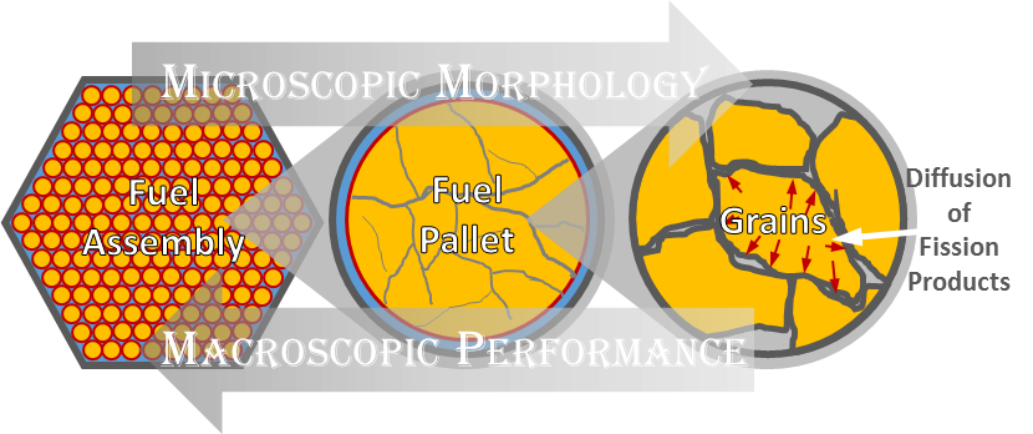
Fission gas release from nuclear fuels is a critical effect in terms of induced fuel swelling and the associated pellet cladding mechanical interaction (PCMI). Understanding this behavior involves the study of microscopic morphology of fuel materials as well as the diffusion behavior of the fission gases (i.e. Krypton and Xenon). Previous studies have shown that the uncertainties related to the intra-granular diffusion of fission gases are the most limiting factors that hinder the overall accuracy of fission gas release calculations. Measurement of the diffusion coefficient under better controlled conditions and with higher accuracy becomes crucial in predicting the fuel performance and in using the modern computational nuclear analysis tools.
The FGRM Facility at PULSTAR
The Fission Gas Release Measurement (FGRM) facility is located at beamport #1 of the PULSTAR reactor. The facility contains a heating furnace and an open loop that carries out the released fission gas to the detector system. The furnace allows the irradiation of uranium dioxide (UO2), uranium silicide (U3Si2), and any other types of particle fuel samples at various temperatures up to above 1000°C. A concrete shield room will be built around the FGR system to reduce the radiation levels to normal background while the reactor is operating. Controls of the main FGR system and the detector system are located outside the shield room.

System Design
The FGR measurement facility should enable the irradiation of fuel samples under accurately controlled conditions, especially controlled temperatures and calibrated neutron flux. The distinct advantage of this concept over the previous studies is that the temperature is controlled in-situ and monitored within a compact high-temperature furnace inside the beam tube during fuel irradiation, so that the fission gas diffusion behavior can be measured under such conditions. Small crystalline fuel particles are used to minimize any temperature gradient within the fuel. Another advantage of using single crystalline fuel particles is that the diffusion behavior of the fission gases is isotropic and not affected by grain boundaries, hence simple diffusion model can be used to interpret the measurement results. In addition, the total sample mass is chosen to be small so that the heat generated from the fission process can be largely ignored.

A schematic of the conceptual design of the main structure of the FGR measurement facility is shown in the figure above. The fuel particles are represented by an array of spheres placed inside a furnace. The released fission gases will be carried by a stream of Helium sweep gas to the detector, where the amount of radioisotopes is detected and determined. The fission gases have to pass a series of filters before being released to the environment to meet the safety requirements. Since the travel time from the furnace chamber to the detector cannot be ignored, in order to accurately extract the release rate at the fuel, a well-controlled gas flow is also needed.
Detection Limit
The fission gas release rate (R) will be one of the primary observables using this FGR measurement system. The detected fission gas decay at the end of the loop is closely related to the detection efficiency and the transport efficiency of the fission gas isotopes. At steady state, the fission gas flows by the detector at a constant rate, and the measured peak area, , of a specific energy, , of isotope, , can be expressed as
where and are the release rate and the decay rate of isotope , respectively, and is the volume of sweep gas in the transport tube, is the volume of sweep gas the detector sees. is the volumetric flow rate of the sweep gas, is the detector efficiency, is the yield of a specific gamma, and is the counting time of the spectrum. In the equation above, is the travel time () of the fission gas from the fuel to the detector, and represents approximately the period of time () the fission gas stays within the detectable distance of the detector. Therefore, the first exponential before the bracket accounts for the fission gas decay during the transport based on a release rate , and the part inside the bracket accounts for the measurable decay when the gas flows by/around the detector. At steady state with a constant gas flow rate, the detection efficiency is dependent on the detector geometry instead of on time, and the integral efficiency is set by , which can be calibrated experimentally.

The background noise in the reactor bay area is measured with a shield using a 40% HPGe detector. When the reactor is operating at full power of 1MW, the count rate per channel (~1 keV/ch) is below 0.15 cps at low energy range. The detection limit based on this background level would be ~5 cps for a specific peak. With the estimated release rate and transport efficiency, several hundred UO2 microparticles are able to generate decent count rates for most of the interested Kr and Xe isotopes using a typical 40% efficiency HPGe detector. In addition, by adjusting the flow rate of the sweep gas, consequently the transport and detection efficiency, we can optimize the count rate of certain interested isotopes and confirm the linearity of the relationship between the flow rate and the transport efficiency. Based on MCNP and COMSOL simulations, the count rates of specific gamma peaks from 300 UO2 particles (100μm diameter) held at 1000°C are correlated to the sweep gas velocity, as shown in the figures above. It is clear that these count rates well meet the minimum detectability requirement. More importantly, the release rate is directly related to the diffusion coefficient inside the fuel material and the production of the fission gases. By deducing the release to birth ratio, we can calculate not only the diffusion constant of certain fission products in a fuel material, but also its dependence on temperature.
The Sample Holder
One of the most critical components of the system is the sample holding device, which needs to securely hold the fuel particles which are on the order of several milligrams in mass and ~100-500 μm in particle size, while simultaneously allowing the sweep gas to flow through the particles at ~1000˚C and even higher temperatures. The geometry of such a sample holding device is shown in the figures below. The fuel particles are held between two commercially available electroformed SEM grids, which are then enclosed in two cylindrical Molybdenum alloy (TZM) pieces with center holes. The meshes meet several requirements in this situation: small size (~3 mm in diameter) with a variety of opening sizes (100-500 μm) available for different types of fuel particles; the open area is >50% allowing sweep gas flow; high system temperature requirement; commercially available and cost effective. The figures on the right show micrographs of dummy stainless-steel particles loaded onto a Molybdenum mesh taken by an optical microscope.

This cylindrical sample insert is designed to work together with a sealed sample holder block that allows the switching out of samples while still maintaining the Helium gas seal. The sample insert and holder block are designed to survive high temperatures and incorporate an Alumina or graphite-based sealing gasket. The figures below show the sample inserts and the sample holder. The sample holder has two functions: a) It mechanically holds the sample block inside the furnace chamber, and b) It provides the gas and power connections between the external gas lines to the sample block. In addition, a clamp-on heat exchanger between the sweep gas lines on the cold side of the stick help to pre-heat the incoming Helium sweep gas using the residual heat of the outgoing sweep gas.

The Furnace
Due to dimensional limitations, and based on the COMSOL simulation results, the sample furnace was designed to be an air-tight high temperature (>1000˚C) furnace, with an outer diameter of <6” and with an Aluminum enclosure which also acts as a water-cooling jacket. This jacket actively maintains a safe external temperature with water circulation controlled by a water chiller. The heating element is made with TZM filaments. These heating filaments are configured into 8 pairs with one end connected so that it fits into the 16 grooves of the 99.6% pure Alumina candle. The multiple pairs of 0.5mm heating filaments provide enough redundancy, heating uniformity, and sufficient lifetime at high temperature. An illustration of the furnace and pictures of the assembled sample chamber is shown below.


Facility Shielding
A shield room is built around the instrument to reduce the radiation level to background when the reactor is at full power. This shield room is composed of multiple concrete blocks of 12″-36″ thick.

Testing of the Facility
Currently, the major components of the FGL measurement facility have been tested, and the license amendment for fueled experiment has been approved by NRC. We welcome requests for measurements and collaborations from both academic institutions and industrial partners. Please contact the Manager of Nuclear Services if you are interested in learning more about applications of the FGR measurement facility.
